Emboh: A Practical Evaluation of a Modern Handwritten Display Font
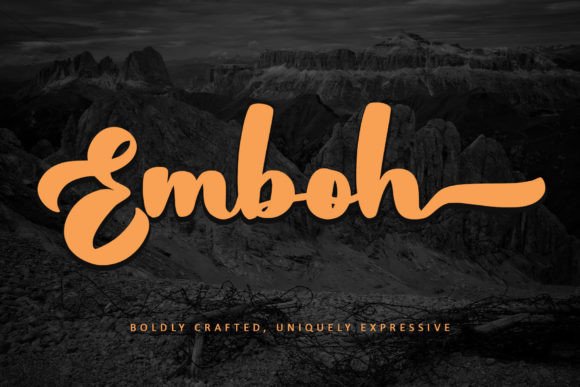
In the landscape of digital typography, the distinction between a functional typeface and a statement piece often lies in the balance of legibility and character. Emboh enters this space as a bold handwritten font designed to define modern sophistication. It is not merely a script meant to mimic handwriting; rather, it is a curated set of strokes intended to inject dynamic flair into design projects while maintaining a high degree of readability. For designers, marketers, and content creators aged 20 to 50 who are evaluating their typographic toolkit, understanding where Emboh fits—and where it does not—is crucial for making informed decisions.
The primary appeal of Emboh is its ability to blend casual charm with a touch of boldness. Unlike delicate scripts that can vanish against complex backgrounds or lose impact at smaller sizes, Emboh utilizes striking strokes that command attention. This makes it particularly effective for headlines, logos, and short-form copy where visual weight is a priority. However, like any specialized tool, its utility depends heavily on the specific context of the project. Before integrating Emboh into a workflow, it is necessary to examine its structural characteristics, technical capabilities, and how it compares to broader categories of display fonts.
Analyzing the Design Philosophy and Visual Impact
At its core, Emboh represents a shift away from the rigid uniformity of traditional serif and sans-serif families toward a more organic aesthetic. The font's architecture relies on variable stroke widths and fluid transitions, mimicking the natural movement of a hand holding a marker or brush. This "handwritten" quality is what provides the casual charm, but the execution is refined to avoid the messiness often associated with amateur calligraphy.
When evaluating Emboh against standard display fonts, the difference in emotional resonance becomes apparent. Standard geometric sans-serifs convey stability and neutrality, while traditional serifs suggest heritage and authority. Emboh occupies a middle ground, offering approachability without sacrificing professionalism. This makes it an excellent choice for brands aiming to appear innovative yet grounded. The boldness of the characters ensures that they remain distinct even when used in isolation, such as on packaging or social media graphics, where immediate visual recognition is required.
However, the very traits that make Emboh distinctive also dictate its limitations. The dynamic flair means that letterforms may vary significantly in width and shape. While this adds character, it requires careful kerning and spacing adjustments. In a paragraph of body text, these variations could disrupt reading flow, leading to eye strain. Therefore, the evaluation of Emboh must consider its role as a display typeface rather than a body text solution. It is designed to be seen, not necessarily read in long blocks.
Technical Advantages: PUA Encoding and Glyph Accessibility
A significant factor in the practical application of Emboh is its technical encoding. Many modern fonts rely on OpenType features to access alternate characters, which can sometimes cause compatibility issues across different operating systems or older design software. Emboh addresses this by utilizing Private Use Area (PUA) encoding. This approach ensures seamless access to a plethora of glyphs and swashes without relying on complex feature triggers that might fail in certain environments.
For a designer managing multiple platforms, this reliability is a tangible benefit. PUA encoding allows for the direct selection of unique characters, ligatures, and decorative elements directly from the character map. This includes swashes—decorative extensions of letters—that can transform a simple word into a stylized logo. When comparing this to fonts that require specific software versions to activate alternates, Emboh offers a lower barrier to entry and greater consistency across devices.
The inclusion of these extra glyphs expands the creative possibilities. A single word can be rendered in multiple ways simply by swapping standard characters for their swashed counterparts. This flexibility is essential for creating unique brand identities where repetition of the exact same letterform would look static. However, users should be aware that relying heavily on PUA characters can sometimes complicate web embedding if the browser support is not verified, though this is less of an issue for print and static graphic design.
Comparing Emboh to Alternative Typography Styles
To determine if Emboh is the right fit, it helps to compare it against other common typographic approaches. One frequent alternative is the use of "brush script" fonts. While similar in their organic feel, many brush scripts lean heavily into the messy, energetic side of handwriting. They can appear chaotic if overused. Emboh distinguishes itself through a more controlled structure. It retains the energy of a brush stroke but applies a level of discipline that keeps the text legible and sophisticated.
Another comparison point is the category of "modern calligraphy." These fonts often prioritize elegance and thin lines, making them beautiful but fragile. They work well for wedding invitations or luxury branding but may lack the punch needed for bold headlines or streetwear aesthetics. Emboh fills the gap between these delicate styles and heavy block letters. It offers the personal touch of calligraphy with the visual weight of a headline font.
When considering digital alternatives, some designers opt for vector illustrations of text rather than using a font file. While this offers total control, it is time-consuming and lacks the scalability of a true typeface. Emboh provides a scalable solution that mimics the uniqueness of custom illustration but with the efficiency of a font file. This tradeoff between customization speed and artistic control is a key decision factor. If a project requires rapid iteration of headlines, Emboh is superior to manual illustration. If absolute uniqueness is paramount and no two words can ever look alike, custom lettering remains the only option.
Strengths and Tradeoffs in Real-World Application
- Visual Impact: Emboh excels in grabbing attention due to its bold strokes, making it ideal for headers and posters.
- Versatility: The PUA-encoded swashes allow for quick stylistic variations without needing external assets.
- Readability Limits: Due to its decorative nature, it is not suitable for long-form body text or small UI elements.
- Pairing Requirements: It works best when paired with a neutral sans-serif or slab serif to balance the visual noise.
Determining the Right Context for Emboh
Deciding whether to use Emboh ultimately comes down to the specific goals of the project. It is the right choice when the objective is to humanize a brand or add a personal signature to a design. For example, a startup looking to break away from corporate sterility might use Emboh for their main slogan to signal creativity and approachability. Similarly, event planners designing flyers for festivals or workshops can leverage its dynamic flair to create excitement.
Conversely, there are scenarios where Emboh may not be the optimal resource. Projects requiring strict adherence to formal standards, such as legal documents, academic papers, or financial reports, should avoid this style. The inherent informality of a handwritten font can undermine the perceived seriousness of such content. Additionally, if the target audience includes individuals with visual impairments, the variable stroke widths and potential for complex ligatures in Emboh could pose accessibility challenges. In these cases, a highly legible, standard sans-serif is the responsible alternative.
Another consideration is the medium. Emboh shines in static media like print, packaging, and digital banners where the viewer has time to appreciate the details. In rapidly moving media, such as scrolling social media feeds or video subtitles, the complexity of the font might reduce instant readability. Designers should test the font at the intended size and resolution before committing to ensure the "boldness" does not turn into visual clutter.
Strategic Pairing and Implementation
To maximize the effectiveness of Emboh, strategic pairing with complementary typefaces is essential. Because Emboh carries significant visual weight and personality, it should be balanced with a typeface that recedes into the background. A clean, geometric sans-serif or a straightforward slab serif works well to provide contrast. This combination allows Emboh to serve as the focal point while the secondary font handles the informational load.
Implementation also involves restraint. Using Emboh for every line of text dilutes its impact. The most effective designs often reserve this font for key phrases, titles, or calls to action. By limiting its usage, the font retains its novelty and power. Furthermore, taking advantage of the PUA-encoded glyphs should be done thoughtfully. Overusing swashes can make text difficult to decipher, so selecting one or two key letters to embellish often yields a more elegant result than decorating every character.
In conclusion, Emboh represents a robust option for those seeking a blend of elegance and ease in their typography. Its distinct character, supported by reliable PUA encoding, offers a practical solution for creating standout headlines and adding a personal touch to various projects. While it is not a universal replacement for all typefaces, its strengths in specific contexts make it a valuable addition to a professional design toolkit. By understanding its limitations and pairing it correctly, designers can elevate their projects with a font that truly defines modern sophistication.