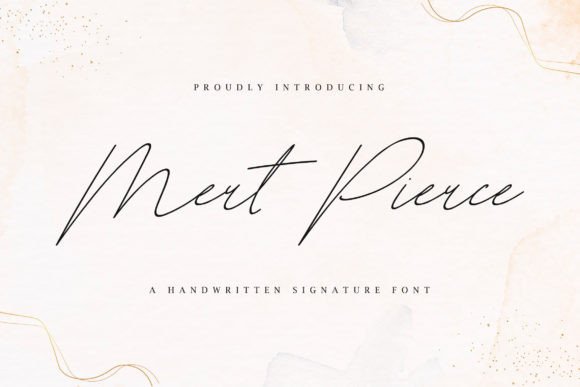
Evaluating Mert Pierce: A Handwritten Signature Font
In the realm of digital typography, the demand for fonts that convey human connection and authenticity has grown significantly. Designers often seek typefaces that break away from the rigid uniformity of standard sans-serifs or serifs to introduce a sense of personal touch. Mert Pierce is a handwritten signature font designed specifically to address this need. It aims to replicate the fluid strokes and natural flow of a genuine pen on paper, offering a distinct aesthetic for branding, logo design, and product packaging. For professionals evaluating their typographic options, understanding the specific characteristics, applications, and limitations of Mert Pierce is essential for making an informed decision.
Understanding the Design Philosophy of Mert Pierce
Mert Pierce is not merely a collection of letters; it is a digital interpretation of the act of signing one's name. The core design philosophy revolves around capturing the essence of a handwritten signature. Unlike geometric or slab-serif fonts that prioritize structural consistency, Mert Pierce embraces irregularity. The font features varying stroke widths, subtle tremors in the baseline, and connecting ligatures that mimic the continuous motion of a hand.
This approach creates a visual rhythm that feels organic rather than manufactured. When examining the glyphs closely, one can observe the "lift" and "press" dynamics typical of calligraphy, though executed with a modern, clean finish. This balance between the chaotic nature of handwriting and the legibility required for commercial use defines the utility of the font. It is designed to function as a standalone element—such as a brand mark—or as a complementary accent to more structured body text.
Reasons to Consider Mert Pierce for Your Projects
Designers and business owners might be drawn to Mert Pierce for several strategic reasons. The primary driver is often the desire for authenticity. In a market saturated with digital perfection, a font that suggests human involvement can foster trust and relatability. Mert Pierce offers a way to inject personality into a brand identity without requiring custom lettering services, which can be time-consuming and expensive.
Additionally, the versatility of the font makes it suitable for various contexts where a formal tone is too stiff. It is particularly effective for:
- Personal Branding: Consultants, coaches, and creatives often use signature-style fonts to sign off on documents, emails, or social media graphics, reinforcing their individual identity.
- Luxury and Craftsmanship: Brands in the fashion, jewelry, or artisanal food sectors frequently utilize script fonts to imply high-quality, hand-crafted goods.
- Wedding and Event Invitations: The elegant flow of Mert Pierce aligns well with the romantic and personalized nature of event stationery.
- Product Packaging: Labels on bottles, boxes, or tags benefit from the unique character of the font, distinguishing the product on a crowded shelf.
Benefits and Tradeoffs: A Practical Analysis
While Mert Pierce offers distinct aesthetic advantages, it is crucial to weigh these against potential tradeoffs. The most significant benefit is the immediate establishment of a mood. The font conveys elegance, sophistication, and warmth simultaneously. It allows a designer to achieve a "hand-lettered" look quickly, streamlining the workflow for projects that require a bespoke feel.
However, there are inherent challenges associated with signature-style fonts. The primary tradeoff is legibility at small sizes. Because the font relies on fluid strokes and connected letters, reducing the size for body copy or fine print can render the text difficult to read. The intricate details that give Mert Pierce its charm can become muddy or indistinct when scaled down or printed on low-resolution materials.
Another consideration is the perception of formality. While elegant, a handwritten font may not convey the authority or stability required for certain industries, such as law, finance, or heavy industrial manufacturing. In these contexts, a serif or sans-serif typeface might communicate reliability more effectively. Furthermore, because the font mimics a specific style of handwriting, overuse can lead to a lack of visual hierarchy if not paired carefully with neutral supporting fonts.
Situations Where Mert Pierce is a Strong Fit
Mert Pierce excels in scenarios where the goal is to highlight individuality and emotional connection. It is a strong fit for logos that serve as the primary visual identifier for a lifestyle brand. For example, a boutique coffee shop or a handmade soap company can leverage the font to emphasize the "human behind the product."
It is also highly effective for headlines and titles in editorial layouts. When used sparingly to draw attention to a key phrase, the unique personality of Mert Pierce can break up blocks of standard text and guide the reader's eye. Additionally, in digital marketing campaigns focused on storytelling, using this font for quotes or testimonials can enhance the perceived sincerity of the message.
When to Consider Alternatives
Despite its strengths, Mert Pierce is not a universal solution. There are specific situations where alternative typefaces would be a more prudent choice. If the project requires extensive body text, such as a website article, a book, or a legal contract, a readable sans-serif or serif font is mandatory. Attempting to use Mert Pierce for long-form content will likely result in reader fatigue and poor user experience.
Furthermore, if the brand identity relies on minimalism and stark modernity, the ornate nature of a signature font might clash with the overall design language. In cases where the target audience expects strict professionalism or technical precision, a cleaner, more geometric font should be considered. Finally, if the design system requires multiple weights (light, regular, bold, italic) for complex hierarchy, Mert Pierce may fall short if it is only available in a single weight or limited variations.
Decision-Making Insights for Selecting Mert Pierce
To determine if Mert Pierce aligns with your specific goals, consider the following practical steps during the evaluation process:
- Test Legibility: Create mockups of your intended application at various sizes. Zoom out to see how the font performs on mobile screens or small packaging labels. If the characters blur together, the font may not be suitable for that specific use case.
- Check Pairing Compatibility: Evaluate how Mert Pierce interacts with other fonts. Since it is expressive, it generally pairs best with simple, neutral fonts that allow it to stand out without competition.
- Assess Brand Alignment: Ask whether the "handwritten" aesthetic supports the brand values you wish to communicate. Does it reinforce the message of craftsmanship and care, or does it undermine the perception of professionalism?
- Review Licensing: Ensure that the licensing terms for Mert Pierce cover your intended scope of use, whether for personal projects, commercial products, or web integration.
Ultimately, the decision to use Mert Pierce should be driven by the specific narrative of the project. It is a tool for adding character and warmth, but like any specialized tool, it works best when applied with intention and restraint. By understanding its strengths and limitations, designers can harness the unique charm of Mert Pierce to create work that feels both authentic and professionally executed.