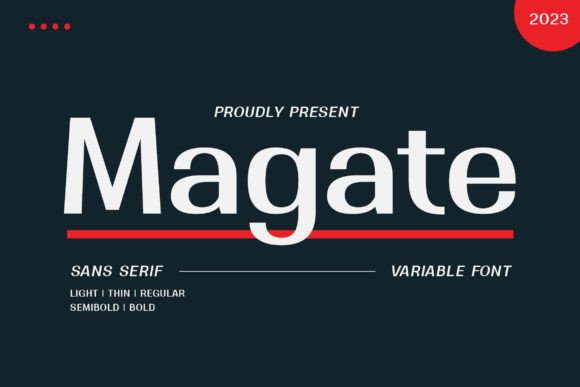
Redefining Digital Typography with Magate: A Variable Sans Serif for the Modern Creator
In the rapidly evolving landscape of digital design, typography remains the silent architect of communication. It dictates how information is consumed, how brands are perceived, and how users interact with interfaces. As we move further into an era defined by responsive web design, multi-platform content strategies, and immersive user experiences, the tools available to designers must evolve in tandem. Enter Magate, a groundbreaking sans serif variable font that represents more than just a new typeface; it signifies a shift in how professionals approach typographic versatility and precision.
For years, designers have been constrained by the limitations of static font files. Choosing between bold, italic, or light often meant committing to specific weights early in the process, limiting flexibility during iteration. Magate dismantles these barriers, offering a fluid spectrum of styles within a single file. This innovation empowers creators to customize typography with a level of granularity previously reserved for custom type foundries, making high-end typographic control accessible to freelancers, agencies, and enterprises alike.
The Evolution of Type: Why Variable Fonts Matter Now
To understand the significance of Magate, one must look at the broader trajectory of the design industry. We are witnessing a convergence of technology and aesthetics where efficiency meets artistry. The rise of variable fonts is not merely a technical upgrade; it is a response to the changing needs of the digital ecosystem. In a world where content must render flawlessly on everything from smartwatches to 8K monitors, the ability to adjust weight, width, and slant dynamically is no longer a luxury—it is a necessity.
Traditional workflows required designers to manage multiple font files for different weights, bloating website load times and complicating asset management. Variable font technology solves this by condensing an entire family of fonts into a single, lightweight file. Magate leverages this architecture to provide a sleek and stylish typographic solution that adapts to context without sacrificing performance. This aligns perfectly with current market trends prioritizing speed, accessibility, and seamless cross-device compatibility.
Bridging the Gap Between Print and Digital
One of the most compelling aspects of Magate is its ability to bridge the historical divide between print and digital media. Historically, a font designed for print might lack the screen-optimized legibility required for mobile interfaces, while a digital-first typeface might feel too rigid when printed on high-quality stock. Magate was engineered with clean lines and contemporary letterforms that maintain integrity across both mediums.
Consider a branding project where a logo needs to appear on a business card and then animate on a landing page. With Magate, the same underlying geometry can be adjusted slightly for the print version to ensure crisp ink coverage, while the digital version can be tuned for optimal pixel rendering. This fluidity allows for a cohesive brand identity that feels native in every environment, reinforcing the professional image of the business.
Empowering Creativity Through Precision Control
The core value proposition of Magate lies in its granular control. Variable fonts introduce axes of variation—typically weight, width, and sometimes slant—that allow designers to fine-tune the appearance of text in real-time. This capability transforms typography from a static selection into a dynamic design element.
- Dynamic Hierarchy: Instead of relying on pre-set sizes, designers can use Magate to create subtle shifts in weight to guide the reader's eye through complex editorial layouts.
- Responsive Interactions: In user interface (UI) design, Magate can react to user actions. Imagine a button that subtly thickens as a cursor hovers over it, providing tactile feedback purely through typographic changes.
- Brand Differentiation: By selecting unique points along the variable axis, brands can create a distinct visual signature that sets them apart from competitors using standard font families.
This level of customization is particularly relevant for entrepreneurs and marketers who need to produce diverse assets quickly. Whether you are creating social media graphics, email newsletters, or interactive dashboards, Magate ensures that your typography remains consistent yet adaptable. It eliminates the friction of switching between files, streamlining the creative workflow and allowing teams to focus on strategy and storytelling rather than asset management.
Modern Aesthetics for Contemporary Brands
Aesthetically, Magate embodies the modernist principles that dominate current design trends. Its sans serif structure is characterized by open apertures, balanced proportions, and a neutral yet distinctive voice. These clean lines ensure high legibility even at small sizes, a critical factor for mobile-first design strategies.
However, neutrality does not mean boring. The contemporary letterforms of Magate possess a subtle personality that makes them suitable for a wide range of applications. For tech startups, the font conveys innovation and clarity. For lifestyle brands, its sleek profile suggests sophistication and minimalism. For editorial projects, its readability supports long-form content without causing eye strain. This versatility makes it a staple choice for design studios looking for a "workhorse" font that can elevate any project.
Shifting Workflows and Expectations
The adoption of tools like Magate reflects a deeper shift in professional expectations. Clients and stakeholders today demand faster turnaround times and more personalized outputs. The traditional model of "pick a font, stick with it" is giving way to a more iterative, data-driven approach to design. Teams are expected to prototype rapidly, test variations, and deploy updates seamlessly.
Variable fonts facilitate this agile workflow. Because Magate offers a continuous range of styles, designers can experiment with different combinations of weight and width without needing approval for new font licenses or waiting for developers to implement new files. This democratization of design power means that smaller teams can achieve results that were once only possible for large corporations with dedicated type departments.
Furthermore, the integration of variable fonts into major design software and CSS specifications has lowered the barrier to entry. What was once a niche feature for advanced typographers is now a standard tool in the arsenal of every graphic designer and frontend developer. Magate capitalizes on this widespread adoption, ensuring that users can leverage its full potential across their existing tech stacks.
Practical Applications Across Industries
The utility of Magate extends far beyond generic design projects. Let us explore how different sectors are leveraging its capabilities:
- E-Commerce and Retail: Online stores rely heavily on clear product descriptions and compelling calls to action. Magate's variable weight allows for dynamic emphasis on sale prices or key features, improving conversion rates through better visual hierarchy.
- Publishing and Media: Digital magazines and news outlets benefit from the font's readability. Editors can adjust the tracking and weight of Magate to fit varying column widths and screen densities, ensuring a premium reading experience.
- Software Development: For UI/UX designers building SaaS platforms, consistency is key. Magate ensures that labels, buttons, and headers maintain a unified look while adapting to dark mode, light mode, or high-contrast settings.
- Personal Branding: Freelancers and influencers use Magate to create cohesive content across Instagram, LinkedIn, and personal websites. The font's modern aesthetic helps establish a professional and forward-thinking persona.
Looking Forward: The Future of Typographic Expression
As we look toward the future of digital interaction, the role of typography will only grow more central. With the advent of augmented reality (AR), virtual reality (VR), and spatial computing, text will need to exist in three-dimensional spaces, reacting to movement and perspective. While these technologies are still maturing, the foundation laid by variable fonts like Magate prepares the industry for these advancements.
The ability to manipulate type in real-time is a precursor to fully adaptive environments where text responds to user behavior, environmental lighting, or contextual data. Magate is not just a font for today's screens; it is a flexible framework for tomorrow's interfaces. By embracing this technology now, designers position themselves at the forefront of a typographic revolution that values adaptability, performance, and aesthetic excellence.
Ultimately, the decision to use Magate is a decision to prioritize quality and flexibility. It acknowledges that in a crowded digital marketplace, the details matter. The curve of a letter, the thickness of a stroke, and the spacing between words all contribute to the overall perception of a brand. By choosing a tool that offers such precise control, professionals signal a commitment to excellence and a deep understanding of the craft.
Whether you are crafting a new corporate identity, designing a mobile application, or laying out a complex editorial spread, Magate provides the robust, versatile, and modern foundation you need. It invites you to push the boundaries of what is possible with type, turning static text into a dynamic component of your design narrative. In a world that never stops moving, having a font that moves with you is the ultimate advantage.
As the design community continues to embrace these new possibilities, Magate stands as a testament to the power of thoughtful engineering and artistic vision. It is more than a collection of glyphs; it is an enabler of creativity, a solver of technical challenges, and a partner in the journey toward more engaging, effective, and beautiful digital experiences.