The Crafty Marie: A Practical Evaluation of the Font Duo for Designers and Creators
In the realm of digital typography, finding a typeface that balances professional polish with approachable whimsy is often a challenge. The Crafty Marie emerges as a specific solution to this problem, offering a curated font duo designed to eliminate the guesswork typically associated with pairing disparate styles. Unlike single-style fonts that require external matching or complex kerning adjustments to achieve visual harmony, this typeface provides two distinct yet cohesive voices within one package: a bold, rounded display sans and a smooth, whimsical handwritten script. For adults navigating the intersection of DIY crafting, educational material creation, and children's branding, understanding the practical applications, limitations, and comparative advantages of The Crafty Marie is essential before integrating it into a design workflow.
Understanding the Core Architecture of The Crafty Marie
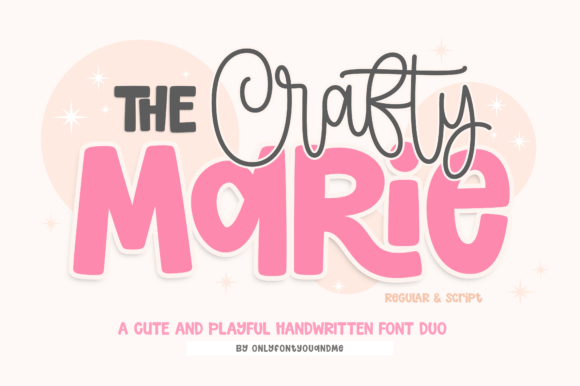
The primary distinction of The Crafty Marie lies in its intentional duality. Most font families offer multiple weights (light, regular, bold) of the same style, but this typeface offers two different stylistic approaches that share a common DNA. The "Regular" style serves as a robust, rounded sans-serif, providing high legibility and structural weight. In contrast, the "Script" variant mimics natural handwriting, introducing fluidity and personal expression. This architecture allows designers to establish instant visual hierarchy without needing to source a secondary font from a different foundry.
From a technical standpoint, the inclusion of Private Use Area (PUA) encoding is a significant feature for users who rely on decorative elements. PUA encoding ensures that special characters, ligatures, and decorative glyphs are accessible directly within standard design software without requiring additional plugins or third-party converters. This reduces friction in the production process, particularly for users who may not be advanced typographers but need professional-looking results quickly. The clean outlines of both styles are specifically optimized for cutting machines, making them highly relevant for SVG designers and Cricut enthusiasts who require precision in their vector paths.
Comparative Analysis: When to Choose The Crafty Marie Over Alternatives
When evaluating The Crafty Marie against other options in the market, it is crucial to consider the specific context of the project. There are thousands of free and paid script and sans-serif combinations available, but many suffer from a lack of cohesion. Often, a designer will pair a geometric sans-serif with a cursive script only to find that the x-heights do not align or the stroke weights clash, resulting in a disjointed aesthetic. The Crafty Marie solves this by ensuring that the script complements the sans-serif naturally, creating a unified brand voice.
However, this does not mean it is the universal answer for every design scenario. If a project requires formal authority, such as legal documents, corporate annual reports, or academic publications, the playful nature of this typeface would be inappropriate. In those contexts, traditional serif fonts or neutral grotesque sans-serifs remain the superior choice. Similarly, if a design requires extreme versatility across dozens of languages or complex diacritics, a more comprehensive type family with extensive OpenType features might be necessary. The Crafty Marie is best viewed as a specialized tool rather than a general-purpose utility.
For crafters and educators, the comparison often comes down to time efficiency versus customization. While sourcing separate fonts allows for granular control over every aspect of the typography, it also demands a higher skill level to ensure they work together. The Crafty Marie trades some degree of absolute customization for speed and guaranteed compatibility. This tradeoff is often favorable for creators who prioritize output speed and a consistent "look and feel" over unique, bespoke font engineering.
Evaluating Visual Hierarchy and Readability
One of the strongest arguments for using this font duo is its ability to manage visual hierarchy effortlessly. By utilizing the bold "Regular" style for primary headlines and the "Script" for subheads, taglines, or accent text, designers can guide the viewer's eye through the content naturally. The rounded nature of the sans-serif softens the impact of the message, making it less aggressive than sharp-edged alternatives, while the script adds a layer of intimacy.
Readability is another critical factor. While scripts are often criticized for being difficult to read in long paragraphs, The Crafty Marie is designed with short-form applications in mind. It excels in invitations, signage, and social media graphics where text volume is low. Attempting to use the script style for body copy in a newsletter or a book chapter would likely result in poor readability and should be avoided. In these longer-form scenarios, the "Regular" sans-serif could serve as a viable body font, though it still retains a playful character that may not suit serious narrative text.
Practical Applications and Workflow Integration
The utility of The Crafty Marie extends beyond simple aesthetics; it influences the entire design workflow, particularly for those working with physical media. For SVG designers and users of vinyl cutters, the clean, easy-to-cut outlines are a tangible benefit. Many decorative fonts contain thin lines or intricate details that can break during the cutting process or fail to adhere properly to materials. This typeface avoids those pitfalls, ensuring that digital designs translate accurately to physical products like stickers, t-shirts, and mugs.
To maximize the visual impact of the design, practitioners often employ specific techniques. Using contrasting "candy" colors can enhance the playful energy inherent in the font's structure. Alternatively, adding a thick white offset behind the text creates a sticker effect, which is particularly effective for layered crafts or nursery art. These techniques leverage the font's rounded geometry, allowing the shapes to pop against various backgrounds without losing definition.
For educators creating classroom materials, the approachable nature of the font aids in engagement. Children respond well to rounded, friendly typography, which can make learning materials feel less intimidating. Whether designing flashcards, reward charts, or bulletin board headers, the cohesive look provided by the duo ensures that the classroom environment feels organized yet energetic. This consistency is harder to achieve when mixing fonts from different sources, where subtle differences in curvature or weight can create visual noise.
Limitations and Decision Factors
While The Crafty Marie offers significant benefits for its target audience, potential users must weigh certain limitations. The most notable constraint is the scope of its application. It is inherently a display font, meaning it is intended for large sizes and short bursts of text. It lacks the neutrality required for professional business communications outside of the creative or educational sectors. Additionally, while the PUA encoding simplifies access to decorative elements, it relies on the user's familiarity with how to trigger these glyphs in their specific software, which may present a minor learning curve for beginners.
Another consideration is the risk of overuse. Because the font has a very distinct personality, using it too frequently across different projects can lead to a repetitive brand identity. Designers should evaluate whether the playful tone aligns with the long-term vision of their brand or project. If a brand plans to mature or shift towards a more sophisticated aesthetic in the future, relying heavily on a whimsical font like this might limit flexibility later on.
Determining the Right Fit
Ultimately, the decision to adopt The Crafty Marie depends on the specific goals of the project. It is the right choice when:
- The project targets children, parents, or hobbyists.
- Speed and ease of pairing are prioritized over custom font engineering.
- The design involves physical cutting or vinyl application where clean outlines are vital.
- A friendly, energetic, and approachable tone is required.
Conversely, readers should look for alternative options if:
- The content requires formal or serious tonal delivery.
- Long-form body text needs to be set in a script style.
- Extensive multilingual support or complex typographic features are mandatory.
- The brand identity demands a minimalist or ultra-modern aesthetic that conflicts with rounded, playful forms.
In conclusion, The Crafty Marie represents a thoughtful solution for a specific segment of the design community. By bundling a complementary sans-serif and script, it streamlines the creative process for crafters, educators, and brand designers. While it is not a replacement for comprehensive type families in all contexts, its strengths in visual hierarchy, cutting machine compatibility, and stylistic cohesion make it a valuable asset for those aiming to create engaging, professional, and playful designs with minimal effort.